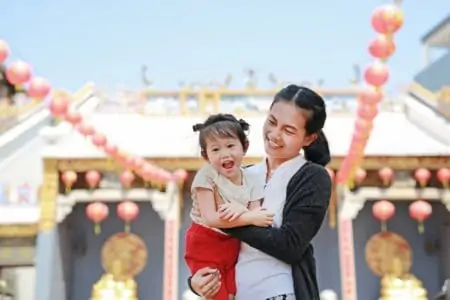
Chinese girl names are some of the most beloved and intriguing names to choose from today.
Chinese parents consider it a great honor and responsibility when naming their child. While taking the exact season and moment of a child’s birth into account, they also consider the child’s unique destiny and seek to use characters that are harmonious, rich in meaning, and pleasing to the ears.
If you’re looking for a diverse selection of Chinese names for your daughter, then take a peek and discover some unusual, cute, unique, and popular names available for you to choose from.
100 Beautiful Chinese Names for Girls
You may get a little lost in all the cuteness of these Chinese girl names.
Āh Kum
Āh Kum is something unique and traditional all rolled into one. You won’t hear this name too often, making it all the more attractive as a “one in a million” name for your beloved daughter.
- Origin: Chinese
- Meaning: Good as gold
- Pronunciation: aah-kum
- Variations:Ah Kim, Ah Kem, Ah Kom, Ah Kaum
- Popularity: Āh Kum is considered a rare Chinese girl name.
Āh-lam
Āh-lam offers a glorious meaning for a family who values peace and harmony. This lovely name is typically heard in both Chinese and Chinese American families. With different hanzi characters, it can also mean “like an orchid.”
- Origin: Chinese
- Meaning Peace
- Pronunciation: aah-laam
- Variations: Āh-Lan, Āh-Lyan, Āh-Lama
- Namesakes: Ahlam is a famous Emirati singer and judge for singing competitions.
- Popularity: Āh-lam is quite rare among Chinese girl names.
Ài
Ài is a gorgeous unisex name, popular in Indonesia, Vietnam, and China. Several people among royalty are also known for having this name, such as King Ài of Zhou, who was the 29th ruler of the Chinese Zhou Dynasty in 441 BC. Emperor Ài of Tang also had this endearing name, who ruled until his murder at the tender age of 15 in 908. Ài can also mean “friendly or lush.”
- Origin: Mandarin
- Meaning: Lovable, affection
- Pronunciation: aahi
- Variations: Aï, Aî, Ayi, Aji
- Namesakes: Ài Carina Uemura, known as Ài, is a Japanese-American singer-songwriter.
- Popularity: Ài is a pretty popular name among Chinese families.
Ànhé
Ànhé carries a peaceful attraction to it that is difficult to resist. If broken down, “Àn” means “calm or peaceful,” while “Hé” refers to a lily. “Àn” can also mean “to agree implicitly” or “of one mind.” This could certainly make a charming name for parents who treasure harmony and unity in their lives.
- Origin: Chinese, Vietnamese
- Meaning: To agree, of one mind, calm, peaceful
- Style: Classic, Cute
- Pronunciation: aan-hwu
- Variations: Hanhe, Ganhe, Anher
- Popularity: Ànhé is a less common name among Chinese girls.
Áo
Áo is usually heard in families from China, Vietnam, Macau, and Hong Kong. This beautiful Chinese name element may inspire a sense of purpose and determination in the life of your sweet child. Áo could even make a wonderful middle name for the more multicultural families out there.
- Origin: Mandarin
- Meaning: Proud
- Pronunciation: ouw
- Variations: Aô, Hao, Gao, Aho
- Popularity: Áo has remained a fairly common Chinese name.
Bái
Bái originates as a Chinese surname of the Mongolian people. This common name is also used as a first name or part of other Chinese name elements. You will also come across an ethnic group and language with this name, from Yunnan province. Traditionally, the Bái people are believed to hold the color white in high esteem. A name such as this may wonderfully capture the beautiful innocence and new life about to arrive.
- Origin: Cantonese
- Meaning: White, crystal clear
- Pronunciation: buy
- Variations: Baï, Baie, Bhai, Baij
- Namesakes: Michelle Bái is a Chinese actress and singer. Bái Lòulóng, or Lou Pai, is a Chinese American businessman and former executive for Enron.
- Popularity: Bái has remained a pretty common name among Chinese people.
Báihé
If you want a lovely two-syllable name to capture the elegance of your new daughter, then Báihé could be a keeper. Báihé is also the name belonging to many Chinese towns, counties, or districts. Báihé County is located in the southeastern portion of Shaanxi province.
- Origin: Mandarin
- Meaning: Lily
- Pronunciation: bai-hyu
- Variations: Baie, Baih, Bayihe, Baihei
- Namesakes: Bai Báihé is one of the highest-earning Chinese actresses, best known for starring in films such as Love is Not Blind, Monster Hunt, and Go Away Mr. Tumor.
- Popularity: Báihé is considered pretty popular among Chinese female names.
Baózhài
If you’re looking for something a little more unusual, then Baózhài could be a wonderful choice! This interesting name refers to a favorite hair accessory among Chinese people, both worn by men and women in ancient China. Depending on the material used and the design, hairpins were traditionally used to show the wearer’s social status. They can be made from a wide range of materials, such as gold, silver, jade, bamboo, wood, tortoiseshell, and bone.
- Origin Chinese
- Meaning: Precious hairpin
- Pronunciation: bouy-jai
- Variations: Baozhi, Baozai, Baochai, Baocai
Bīngqīng
Bīngqīng could be just the perfect name for your new girl! A wonderful way to show the unmatched beauty and awe of the new life about to enter your world.
- Origin: Chinese
- Meaning: Clear as ice
- Pronunciation: been-ching
- Variations: Binqing, Bingqin, Binqin, Benqing
- Namesakes: Hu Bīngqīng is a Chinese actress, best known for her roles in The Whirlwind Girl, The Legend of Qin, and The Legend of Dugu.
- Popularity: Bīngqīng is fairly common among Chinese female names
Bìyù
Bìyù sounds perfect for parents who want to show how deeply they value their new daughter. This delightful name is typically heard in China and Taiwan. Bìyù depicts a special stone known as the “supreme nurturer,” representing inner strength, wholeness, and tranquility.
- Origin: Chinese
- Meaning: Jasper, semi-precious stone
- Pronunciation: bee-yuh
- Variations: Biyou, Biyue, Bhiyu
- Popularity: Bìyù is pretty rare among Chinese girl names.



Cǎi Hóng
Cǎi Hóng may be one for the shortlist, especially if you can’t resist the dazzling beauty of a rainbow. Interestingly, this stunning Mandarin name belongs to a paravian theropod dinosaur from China. Cǎi Hóng may be a wonderful way to show the promise of a new and beautiful life for your precious girl.
- Origin: Mandarin
- Meaning: Rainbow in the sky
- Pronunciation: ky-hwong
- Variations: Cǎiyong, Chia-Hong, Ki-Hong
- Popularity: Cǎi Hóng is considered pretty rare among Chinese female names.
Chángcháng
Since doubled names are often seen as terms of endearment, Chángcháng could be a special way to show your love for your new daughter. If separated, Cháng features as a common Chinese surname rated 80th in the Song-era Hundred Family Surnames text. A stunning name to depict the beautiful future awaiting your baby girl.
- Origin: Chinese
- Meaning: Flourishing
- Pronunciation: chang-chang
- Variations: Chengchang, Chongchang, Changcheng
Cheok-Jin
Cheok-Jin could make a wonderful one for the shortlist if you want something a little more unique and rich in meaning. In Cantonese, “Cheok” means brilliant or profound, while “Jin” means “beautiful.” A special way to capture the unrivaled beauty of your little bundle.
- Origin: Cantonese
- Meaning: Brilliant, beautiful
- Pronunciation: churk-yeen
- Namesakes: Choi Cheok-Jin, better known as Charlotte Choi, is a Hong Kong Canadian actress and singer and a member of the cantopop group Twins.
- Popularity: Cheok-Jin is less common among Chinese girl names, while Cheok is more popular.
Chiu
If you’re looking for a charming, more versatile Chinese name, then Chiu is quite a winner. This beautiful Cantonese name is also spelled Ciu and is typically heard in China, Singapore, and Malaysia. Chinese American parents have also grown attached to the name Chiu. It could certainly be a lovely way to show strength and longevity on your daughter’s new journey.
- Origin: Cantonese
- Meaning: To resemble
- Pronunciation: cheeu
- Variations: Chieu, Chiou, Chiju, Chihu
- Namesakes: Chiu Man-cheuk, better known as Vincent Zhao Wenzhuo, is a Chinese actor and martial artist. He is best known for his role as Wong Fei-hung in Once Upon a Time in China, including the series The Blade, True Legend, and God of War.
Chǔ Huá
Chǔ Huá represents a popular flower mostly native to East Asia, known in traditional Chinese medicine for offering a wide range of health benefits. “Júhuā-chá” is an infused chrysanthemum tea used for lowering blood pressure, cooling the body, and decreasing inflammation.
- Origin: Chinese
- Meaning: Chrysanthemum
- Pronunciation: chew-hu-ah
- Variations: Cho-Hua, Chui-Ha, Shu-Hua
- Popularity: Chǔ Huá is considered very rare among Chinese female names.
Chyou
Chyou refers to one of the all-time favorite seasons of the year. A season known in ancient times for harvesting and preparation for the winter to come. Chyou could be a wonderful name for parents who hope to see their daughter doing great and marvelous things in her life.
- Origin: Chinese
- Meaning: Sweet autumn
- Pronunciation: chi-yu
- Variations: Chuyou, Chuiyou, Chaiyou
- Popularity: Chyou is very rare among Chinese girl names, not listed on any popularity charts.
Dài yù
If you’re looking for a very intriguing name, then Dài yù could certainly be a stunning choice. This name belonged to the main character, Lin Dài yù, from an 18th-century Chinese novel, the “Dream of the Red Chamber.” Also, the Black Jade River, or Karakash River, is a river in the Xinjian region of China. A wonderful name traditionally representing power, protection, wisdom, and self-control. If your daughter grows up in an English-speaking country, it’s worth considering that kids may turn this into “die you.”
- Origin: Mandarin
- Meaning: Black jade
- Pronunciation: die-yu
- Popularity: Dài yù is very rare among Chinese female names.
Dān
Dān is typically used in Chinese opera when referring to female roles or the leading female. Traditionally, all dāns were played by men, however, this has changed over time. Dān also refers to a rich reddish, orange color or powdered mineral, known for playing a significant role in Taoist culture, where it represents life and eternity.
- Origin: Mandarin
- Meaning: Vermilion
- Pronunciation: dan
- Variations: Dang, Danh, Daan, Dann
- Popularity: Dān was last rated in the top 10 Chinese girl names in the 1980s and 1990s, while it is now a less common name.
Dāndān
Dāndān offers loads of uniqueness and tradition-steeped within a name. Cinnabar is a bright scarlet to a brick-red mineral known as a form of mercury sulfide. Throughout ancient history, this beautiful material has been used for its rich coloration. Notably, in China, it was used for coloring stoneware since the Yangshao culture. It makes perfect sense how Dāndān has managed to captivate the imagination of parents over many centuries.
- Origin: Chinese
- Meaning: Cinnabar
- Pronunciation: dan-dan
- Variations: Dandane, Dhandan, Dhandhan
- Popularity: Dāndān is considered a pretty common name among Chinese girls.
Dà Tái
Dà Tái offers a unique insight into the Chinese language and tradition. This name would usually be given to a girl if parents hoped for a son to be born after her birth. Dà Tái also means “lead-boy” and is traditionally given in families with more than one daughter. This lovely name sure carries a strong sense of hope and ambition.
- Origin: Chinese
- Meaning: Leading a boy in hopes
- Pronunciation: da-ty
- Variations: Datai, Daiti, Ditai, Da-Ti
- Popularity: Dà Tái is uncommon among Chinese names for girls.



Dōngméi
Dōngméi sounds perfect for parents who wish to stay true to their Chinese roots. This beautiful name refers to China’s beloved national flower, the Plum Blossom, recognized as a symbol of strength, humility, and courage. An exquisite name to capture the unmatched beauty of your little bundle!
- Origin: Chinese
- Meaning: Winter plum
- Pronunciation: dong-may
- Variations: Tongmei, Dangmei, Dongmai, Dongmi, Dhongmi
- Namesakes: Xian Dōngméi is a Chinese professional Judo artist and Olympic medalist.
- Popularity: Dōngméi has remained very popular among Chinese girl names.
Éhuáng
Éhuáng is a character in ancient Chinese folk religion, known as one of the Xiang River Goddesses. Otherwise known as the Xiangshuishen, another tradition states that these goddesses or spirits were daughters of Emperor Yao, named É Huáng and Nǚ Yīng (meaning “maiden bloom”). Éhuáng could make a beautiful name for parents who love ancient traditions, together with intrigue and mystery.
- Origin: Mandarin
- Meaning: Beautiful season, August
- Pronunciation: eh-hu-ang
- Variations: Hehuang, Yehuang, Jiehuang
- Popularity: Éhuáng is a pretty rare Chinese girl name, not listed on any popularity charts.
Faa
If you’re keeping an eye out for a strong Cantonese name, then Faa could be a stunning one for the shortlist. You could even use it along with another Chinese name element or as a gorgeous middle name.
- Origin: Cantonese
- Meaning: Flower, blossom
- Pronunciation: fah
- Variations: Faai, Faia, Faay, Faya
- Popularity: Faa is a very rare Chinese name, not listed on any popularity charts.
Fēihóng
Fēihóng could make a beautiful name, especially if you love its dreamy, whimsical appeal. A name that could easily portray the soaring dreams and hopes you likely carry for your new daughter.
- Origin: Chinese
- Meaning: A swan goose soaring high in the sky
- Pronunciation: fih-hwong
- Variations: Feiheng, Feihung, Feiyong
- Namesakes: Yu Fēihóng, or Faye Yu, is a Chinese actress, director, and producer known for starring in award-winning American films and popular Chinese television series.
- Popularity: Fēihóng started to show an increase in popularity, however, it remains a less common name.
Fēn
Here’s an exquisite name choice for a girl sure to bring a sweet fragrance of joy and love into your life. Fēn can be used as both a girl and boy name, however, the Fēn version is usually feminine. The alternative form, Fèn, is more masculine, which means “strive or exert.”
- Origin: Chinese
- Meaning: Fragrance, perfume
- Pronunciation: fin
- Variations: Feon, Feen, Feun
- Popularity: Fēn is considered a common Chinese name.
Fēngmián
Fēngmián is unique to China and Taiwan and would make a gorgeous name for both a girl or a boy baby. A name such as this evokes rich poetic imagery and a sense of tranquility and wholeness.
- Origin: Chinese
- Meaning: Falling asleep in the woods as the breeze swishes through
- Pronunciation: fung-mee-an
- Variations: Fengmin, Fengman, Fangmin, Fangman
- Namesakes: Lin Fēngmián was a Chinese painter, famously known for being a pioneer of modern Chinese painting, where he blended Chinese art with Western styles.
- Popularity: Fēngmián is considered a rare Chinese name.
Fèngyīng
Fèngyīng offers style and ancient intrigue, all rolled into one! This delightful name became popular when Chinese parents sought hope and virtue within their beloved China. In Chinese, phoenixes are known as Fenghuang and typically reign over all birds. Images of this beautiful, mythical bird have appeared on Chinese artifacts for 1000s of years and are known for representing virtue, grace, and immortality.
- Origin: Mandarin
- Meaning: Phoenix beauty
- Pronunciation: fung-yeeng
- Variations: Fengjin, Fending, Fengyin, Fengjing
- Namesakes: Wang Fèngyīng is a Chinese businesswoman and CEO and deputy chair of Great Wall Motor. Li Fèngyīng is a Chinese professional weightlifter.
- Popularity: Fèngyīng rose to fame in the 1950s, where it was rated the 7th most popular Chinese girl name. It remains a pretty popular Chinese name.
Guāntīng
Here’s a lovely name for parents who value strength and honor. Guāntīng could even make a lovely choice if you want to keep your child’s gender a surprise to the very end. If broken down, “tīng” means “court, ” while “guān” means “cap, crown or headgear.” Your little one will likely crown your own life with beauty and a great sense of purpose.
- Origin: Chinese
- Meaning: Cap, crown, headgear
- Pronunciation: gwan-ting
- Variations: Guanteng, Kuanting, Quanting
- Popularity: Guāntīng is less common among Chinese names.
Guìlán
Guìlán could make a sweet name for your gorgeous daughter, particularly if you love the elegant beauty of an orchid plant. A laurel represents victory and honor, while orchids symbolize love, luxury, beauty, and strength. A slightly different name option, and equally as popular and appealing, is Guìyīng, meaning “laurel beauty.”
- Origin: Mandarin
- Meaning: Laurel orchid
- Pronunciation: gwi-laan
- Variations: Guilang, Guilhan, Guilain
- Popularity: Guìlán is fairly common among Chinese female names, listed as the 5th most popular girl name in the 1950s.
Guō
If you’re looking for a strong, popular name, then Guō could be a winner, which literally means “the wall that surrounds a city.” Guō is one of the most common surnames in China, however, it is also used as a first name or middle name for both girls and boys. Many parents from Singapore, China, Hong Kong, and the United States have loved this name over the centuries. Many cultures or languages have acquired different variations of the name, such as “Kwok” in Cantonese, “Kwak” in Korean, and Quach in Vietnamese.
- Origin: Chinese
- Meaning: Fortification
- Pronunciation: GOO-aw
- Variations: Guohe, Guoy, Guoh, Guoi
- Namesakes: Xiaolu Guō is a Chinese British novelist, poet, and filmmaker. Terry Guō is a Taiwanese billionaire businessman and founder of Foxconn. Tina Guō is a Chinese American cellist, erhuist, and composer.
- Popularity: Guō is a very common name among Chinese families.



Heun
Here’s a lovely name choice if you’re hoping to find a sweet, traditional Cantonese name. Heun can also be spelled, Hyun. A wonderful name, bringing the magnificent blooms of an orange lily to mind. These beautiful flowers typically represent warmth, confidence, and honor.
- Origin: Cantonese
- Meaning: Orange lily
- Pronunciation: huun
- Variations: Heung, Cheun, Heyun
- Popularity: Heun is a pretty uncommon name among Chinese girls.
Hóngméi
Hóngméi stands for a beloved tree steeped in Chinese tradition and mythology. The plum blossom grows throughout China and typically beckons the beginning of spring, as winter ends. The plum blossoms grow when winter is still prevalent, so the flowers often symbolize perseverance, hope, and fruitfulness.
- Origin: Mandarin
- Meaning: Red plum blossom
- Pronunciation: hwong-may
- Variations: Hengmei, Hongme, Hangmei, Hongmai
- Namesakes: Qiu Hóngméi is a Chinese professional weightlifter who won the World Championships in 2006 and 2007.
- Popularity: Hóngméi ranked the 7th most popular Chinese girl name in the 1970s and remains a popular name today.
Huìfāng
Huìfāng carries an attractive meaning and gorgeous sound to it! This lovely name is very common among Chinese and Taiwanese families. It may be the perfect name to show how your girl will likely bring a sweet fragrance of hope and joy into your life.
- Origin: Mandarin
- Meaning: Kind and fragrant
- Pronunciation: hwee-fang
- Variations: Haifang, Huifan, Hufang, Chifang
- Namesakes: Szu Huì-fāng is a Taiwanese professional volleyball player.
- Popularity: Huìfāng is common among Chinese names for girls.
Huìlàng
Huìlàng could make a great choice for parents who have a particular fondness for jade, together with all its beauty and rich meaning. In Chinese culture, Jade often symbolizes virtue, justice, truth, and heaven and earth. Another slightly different version is Huìling, which carries the same meaning.
- Origin: Chinese
- Meaning: Wise jade tinkling
- Pronunciation: hwee-lang
- Variations: Huiliang, Huilian, Huilong
- Popularity: Huìlàng is considered very rare among Chinese female names.
Huìyín
Huìyín is derived from the Book of Odes from the name Shi Jing, which means “excellent fame.” This strong and elegant name may keep your young daughter ever inspired to do great things in her life.
- Origin: Mandarin
- Meaning: Excellent fame
- Pronunciation: hwee-yeen
- Variations: Huijin, Haiyin, Hiyain
- Namesakes: Lin Huìyín, known as Phyllis Lin, was a famous Chinese architect and writer. She is known in modern China as the first female architect and was married to Liang Sicheng, the “Father of Modern Chinese Architecture.”
- Popularity: Huìyín is very rare among Chinese girl names.
Huìzhòng
Huìzhòng could make a wonderful name for parents who hope to see wisdom and loyalty in the life of their daughter. You will likely come across this name in China, Taiwan, and Singapore.
- Origin: Mandarin
- Meaning: Wise and loyal
- Pronunciation: hwee-jong
- Variations: Huichong, Houzhong, Huizong, Huzhong
- Popularity: Huìzhòng has remained pretty common among Chinese girl names.
Jiǎ
Jiǎ is a strong and sweet-sounding name for a young girl destined to do marvelous things.
- Origin: Chinese
- Meaning: Good, auspicious, beautiful
- Pronunciation: jee-ah
- Variations: Jiha, Jiat, Jiae, Jiah, Jija
- Namesakes: Tian Jiǎ is a Chinese professional volleyball player. Song Jiǎ is a Chinese actress and singer.
- Popularity: Jiǎ is pretty common among Chinese female names.
Jiāyí
Here’s an adorable name, too difficult to resist for many Chinese parents. Jiāyí has remained a hot favorite for girls in China, Taiwan, Singapore, and Hong Kong. This beautiful name offers both rich meaning and attractive tones. A wonderful name to capture the rich joy entering your world.
- Origin: Mandarin
- Meaning: Pleasant joy
- Pronunciation: jia-yee
- Variations: Jiaayi, Jiahyi, Jiay
- Popularity: Jiāyí is pretty popular among Chinese names for girls, first rising to fame in the early 2000s as the 7th most popular name.
Jiāyíng
Jiāyíng is a unique name that may encourage your daughter to follow her own instincts of bringing comfort and hope to those around her.
- Origin: Chinese
- Meaning: Household flourishing
- Pronunciation: jia-ying
- Variations: Jiying, Jieying, Jiayong, Jiuying
- Namesakes: Pang Jiāyíng is a professional Chinese freestyle swimmer, regarded as one of the best Chinese women in middle and long-distance freestyle swimming. Ye Jiāyíng or Florence Chia-Ying Yeh, is a Chinese Canadian poet and sinologist.
- Popularity: Jiāyíng is slightly less common among Chinese girl names.
Jìng
Jìng mainly features Chinese American families, while in China, Malaysia, and Taiwan, it is also commonly used. Jīng rose to fame from the 1970s when Chinese parents started seeking inner peace amongst all the political chaos. It then remained in the top 10 Chinese girl names until the early 2000s.
- Origin: Mandarin
- Meaning: Tranquility
- Pronunciation: jeeng
- Variations: Jings, Jieng, Juing, Joing
- Namesakes: Wu Jìng is a Chinese actor known for starring in the film The Climber.



Jīngyì
Jīngyì is a name you will mostly come across in families from China and Taiwan. Jīngyì may be perfect for parents who hope their daughter brings peace and harmony to those around her.
- Origin: Chinese
- Meaning: Gentle, deeply respected, quiet, harmony
- Pronunciation: jeeng-ee
- Variations: Jingui, Jingai, Jingoy, Jinghi
- Namesakes: Le Jīngyì is a former professional Chinese swimmer and multiple Olympic medalist. Ju Jīngyì is a popular Chinese actress, starring in television dramas such as In a Class of Her Own.
Juān
A dazzling name for an enchanting little soul! Juān simply rolls off the tongue and is easy to pronounce and spell – making it all the more attractive as a name for your little darling. It could also make a great middle name or term of endearment.
- Origin: Chinese
- Meaning: Beautiful, bewitching, graciousness
- Pronunciation: chian
- Variations: Ajuan
- Popularity: Juān featured in the top 10 Chinese names for girls from the 1980s to 1990s and remains a very common name.
Jūn
Jūn is frequently heard in families from Japan, however, many Chinese parents are also known for taking a liking to it over the years. A name such as Jūn could certainly encourage your daughter to become trustworthy and true.
- Origin: Chinese
- Meaning: To be truthful
- Pronunciation: choon
- Variations: Jiun, June, Jhun, Jaun
- Namesakes: Wen Junhui, better known as Jūn, is a Chinese singer, actor, and songwriter.
- Popularity: Jūn is less common among Chinese girl names.
Kei
Kei is the Cantonese version of the Chinese surname Ji or Qi, however, it is also used as a first name. It is also heard in Japan, Hong Kong, and Myanmar. Kei represents a fascinating and beautiful precious stone, known for displaying a wide color palette, such as colorless, white, yellow, orange, green, lavender, and black. From the early Chinese dynasties, jade was used exclusively by royalty as a symbol of power. Confucius was known for sparking a fascination with this beautiful stone, where it was believed to ward off evil and communicate with the supernatural. Jade also represents virtue, kindness, wisdom, and truth.
- Origin: Cantonese
- Meaning: Jade
- Pronunciation: kee
- Variations: Keyi, Keia, Khei
- Namesakes: Princess Kei, best known as Chikurin-in was a Japanese noble lady from the late Azuchi-Momoyama to the early Edo period. Kim Ji-yeon, known by her stage name Kei is a South Korean singer and actress.
- Popularity: Kei is rare among Chinese girl names.
Kěxīn
Kěxīn may be a bit of a tongue twister, but once you get the hang of it, you may discover its dazzling appeal. No wonder so many Chinese parents across the world have taken a liking to this name. Kěxīn carries a strong sense of determination and purpose.
- Origin: Mandarin
- Meaning: Merit admiration
- Pronunciation: ka-sheen
- Variations: Cexin, Keixing, Kixin
- Namesakes: Zhang Kěxīn is a professional Chinese figure skater. He Kěxīn is a professional Chinese gymnast, World Champion, and Olympic medalist.
- Popularity: Kěxīn is currently very popular among Chinese female names, rated the 7th most popular name in 2020.
Lam
Lam is recognized as both a surname and first name throughout the Asian world today. In Mandarin, the name is recognized as Lan. You will often come across this charming name in Thailand, Vietnam, Malaysia, the United States, and China. Lam is also easy to spell and pronounce, making it all the more attractive as a name to honor your Chinese heritage.
- Origin: Cantonese
- Meaning: Forest
- Pronunciation: lam
- Variations: Lham, Laam, Laim, Lamn
- Namesakes: Pakorn Lam is a Thai singer and actor. Carrie Lam is a television presenter from Hong Kong.
Lányīng
Lányīng offers grace and beauty all rolled into one. An adorable name, also speaking of the unique and elegant flower favored by many Chinese parents. While attractive to the senses and imagination, Lányīng is equally appealing to the ears.
- Origin: Mandarin
- Meaning: Orchid beauty
- Pronunciation: laah-ying
- Variations: Lanjing, Lannying, Lianying
- Namesakes: Lin Lányīng was a Chinese electrical engineer, materials scientist, physicist and politician, known as the “mother of aerospace and semiconductor materials.”
- Popularity: Lányīng was rated the 10th most popular girl’s name in the 1950s and remains fairly common among Chinese girl names.
Lì
Lì has captivated the attention of parents for centuries. While it is also listed as the second most common Chinese surname in the world, it also remains a very common first name. Giving your daughter this affectionate and attractive name may be a wonderful way to honor your beloved Chinese heritage.
- Origin: Mandarin
- Meaning: Beautiful, upright
- Pronunciation: lee
- Variations: Lei, Lai, Lie, Lui
- Namesakes: Lì Bingbing is a Chinese actress and singer.
- Popularity: Lì is a very popular Chinese girl name, remaining in the top 10 from the 1960s to the 1990s. Into the 2000s, it remained in the top 20.
Lìhuá
Lìhuá is pretty popular among Chinese girl names, however, it is also sometimes used for naming boys. Many Chinese and Chinese American families are known for growing attached to this attractive, sweet-sounding name. Lìhuá may be a touching way to capture the new beauty and elegance of your daughter.
- Origin: Chinese
- Meaning: Beautiful and elegant
- Pronunciation: lee-hu-ah
- Variations: Laihua, Leihua, Lishua
- Namesakes: Xie Lìhuá is a professional Chinese long-distance runner.
Líng
Traditionally, Líng is a surname originating from the Zhou dynasty, where court officials responsible for handling ice would be given this name. It is, however, also used as a first name or middle name. Líng certainly carries an angelic appeal to it, which could easily capture the delightful elegance of your baby girl.
- Origin: Mandarin
- Meaning: Exquisite
- Pronunciation: leeng
- Variations: Lieng, Lhing, Luing
- Namesakes: Jia Líng or Jia Yuling is a Chinese xiangsheng performer, comedian, and actress.
- Popularity: Líng rose to fame in the 1980s, where it ranked as the 10th most popular name for Chinese girls. From the early 2000s until now, it remains a very popular name.



Lǐqìn
Here’s a pleasant, melodious name, ready to whisk you away on your favorite tune! Lǐqìn refers to different Chinese musical instruments, all beautiful and unique in their own right. If you treasure music and hope your daughter one day carries a similar appreciation, then perhaps Lǐqìn could be quite a keeper. This special name carries a beautiful, lyrical appeal and may always keep your daughter inspired to follow her dreams.
- Origin: Chinese
- Meaning: Beautiful harp, lute, or zither
- Pronunciation: lee-cheen
- Variations: Liqing, Liuqin, Lieqin, Leiqin
- Namesakes: Lǐ Qìn, also known as Sweet Li, is a famous Chinese actress. Wang Lǐqìn is a retired Chinese professional table tennis player.
Lùlì
Lùlì offers a strong essence of purity and devoted love, which may be attributes you hope to see in your beloved daughter one day. Jasmine flowers, along with their rich perfumed scent, feature as one of the holy flowers in Buddhism. They also symbolize the eternal love in Chinese culture.
- Origin: Chinese
- Meaning: Dewy Jasmine
- Pronunciation: luh-lee
Měihuì
Měihuì offers loads of cuteness in a name for your beautiful daughter and may truly inspire great insight and wisdom in her life. Many Chinese and Taiwanese parents can’t help but fall in love with this sweet name, year after year.
- Origin: Mandarin
- Meaning: Beautiful wisdom
- Pronunciation: may-hway
- Variations: Meishui, Mihui, Mehui, Meihai, Maihui
- Namesakes: Wei Měihuì is a retired Taiwanese para table tennis player and Paralympic medalist.
- Popularity: Měihuì is fairly common among Chinese girl names.
Měiróng
What an adorable name to show the unmatched beauty of your little treasure. When meeting her for the very first time, your heart is likely to never stop smiling. Other stunning name options that could capture her beauty include Měixiāng, meaning “beautiful fragrance,” or Měixiù meaning “beautiful grace.”
- Origin: Chinese
- Meaning: Beautiful countenance
- Pronunciation: may-rong
- Variations: Mirong, Mairong, Meirang
- Popularity: Měiróng is considered a common Chinese name among girls.
Měiyīng
Měiyīng may be the best way to capture the unmatched elegance and potential of your new daughter. You may even love the shorter one-syllable option, Měi, which means “flower.” Both options could even make a wonderful middle name or nickname.
- Origin: Chinese
- Meaning: Beautiful flower
- Pronunciation: may-ying
- Variations: Meiyin, Meijing, Maiying
- Popularity: Měiyīng is considered a fairly common name among Chinese girls.
Mèngyáo
Depending on the Chinese hanzi characters, Mèng can mean “dream,” while “yáo” means “want, will, ask, or demand.” This stylish and strong name could perfectly capture a young girl who is sure to achieve her deepest dreams.
- Origin: Mandarin
- Meaning: Dreaming of jade or beauty
- Pronunciation: mung-yow
- Variations: Mengyu, Mengyi, Mingya
- Namesakes: Xi Mèngyáo or Ming Xi, is a Chinese supermodel who married Mario Ho, the son of Dr. Stanley Ho, a Hong Kong-Macau billionaire.
- Popularity: Mèngyáo recently rose to fame among Chinese girl names, becoming the 10th most popular name in 2020.
Míngxiá
Míngxiá could be a keeper if you love the sound of this enchanting name. It brings a glorious sunrise to mind as the sun’s rays kiss the clouds good morning. Míngxiá speaks of renewal and great new beginnings awaiting your little one.
- Origin: Chinese
- Meaning: Bright glowing dawn clouds or clear halo
- Pronunciation: meeng-sha
- Variations: Minxia, Mingjia, Mengxia
- Namesakes: Fu Míngxiá is a retired Chinese diver and multiple Olympic gold medalist and world champion.
- Popularity: Míngxiá is pretty common among Chinese names for girls.
Míngzhū
Míngzhū may be a lovely name for your pretty princess about to grace you with her presence. In ancient Chinese mythology, pearls are believed to put dragons in eternal pursuit, known as a “dragon-dance.” Pearls usually come from freshwater lakes and rivers in China and are harvested during a full moon in order to absorb the moon’s rich, lunar essence.
- Origin: Chinese
- Meaning: Bright pearl
- Pronunciation: meeng-ju
- Variations: Mingchu, Mengzhu, Mingzhou
- Namesakes: Dong Míngzhū is a Chinese businesswoman currently serving as Chairwoman of Gree Electric.
- Popularity: Míngzhū is considered fairly common among Chinese names for girls.
Nà
Nà became popular among Chinese parents following the implementation of the one-child policy of 1979. Many parents stopped following the tradition of using two names for their children, such as the generational name and personal name, and rather gave their child a short one-syllable name. A name such as Nà would often inspire a sense of hope during a challenging time.
- Origin: Mandarin
- Meaning: Graceful
- Pronunciation: naa
- Variations: Nai, Naz, Nay, Nai
- Popularity: Nà was most popular in the 1980s, where it ranked 7th place in Chinese girl names. It is still pretty popular today.
Ngaa
Here’s an interesting and lovely name you won’t come across too often. So if you’re looking for uniqueness and elegance, Ngaa has it all! This sweet Cantonese name may be a special way to capture the pure and gentle nature you hope to one day see in your daughter.
- Origin: Cantonese
- Meaning: Elegant, graceful
- Pronunciation: ngah
- Variations: Ngaai, Ngaah, Ngaas
- Popularity: Ngaa is considered a very rare Chinese girl name.



Nián Zhēn
A superb name choice if you’re hoping to find a versatile, unisex name. Nián Zhēn offers a rich sense of admirable qualities, such as wisdom and trustworthiness- perhaps some noteworthy traits you wish to nurture in your treasured daughter one day.
- Origin: Chinese
- Meaning: Belief in truthfulness
- Pronunciation: nee-ann-jen
- Variations: Nianchen, Nianzeng, Nianshen
- Namesakes: Wu Nienjen or Wu Niánzhēn, is a Taiwanese scriptwriter, director, and author.
- Popularity: Nián Zhēn is less common among Chinese baby names.
Nǚwā
In Chinese mythology, Nǚwā, also spelled Nügua, is a mother goddess, often referred to as Wahuang (Empress Wa) in traditional Chinese. She is believed to have created humankind and is known for repairing the pillar of Heaven. She is also the sister and wife of Fuxi, the emperor-god. A fascinating and traditional name such as this could be a perfect fit for parents who cherish their Chinese culture and traditions.
- Origin: Mandarin
- Meaning: Mother goddess
- Pronunciation: new-wah
- Variations: Nuway, Nujwa, Nuwaj
Ó-Huáng
If you’re looking for a unique name for your daughter, then Ó-Huáng could be a wonderful choice. Even better if you love the end of summer and the warm beauty it brings. Once you capture the beauty and free-spirited style of this name, you may find yourself falling in love with it!
- Origin: Chinese
- Meaning: Beauty – August
- Pronunciation: oo-hwang
- Popularity: Ó-Huáng is pretty rare among Chinese female names.
Péizhí
Péizhí offers loads of charm and uniqueness in a name for your girl. An elegant flower such as the iris represents hope, courage, and admiration – hopefully qualities you will one day see in the life of your very own “little petal.”
- Origin: Mandarin
- Meaning: Admiring iris
- Pronunciation: pay-jee
- Variations: Peizhai, Peizai, Peizha
- Popularity: Péizhí is very rare among Chinese girl names, not listed on any popularity charts.
Qiàn
Qiàn sounds soft and elegant all at once. A mountain range is also known for having this name, namely the Qiàn Mountains, situated along the China and North Korea border.
- Origin: Mandarin
- Meaning: Beauty
- Pronunciation: chee-an
- Variations: Qiang, Qiane, Qihan
- Namesakes: Yang Qiàn is a Chinese professional sport shooter and Olympic medalist. Qiàn Kun is a Chinese singer and actor.
- Popularity: Qiàn was rated the 8th most popular name in 1980.
Qiáo
Qiáo could be a stunning name for parents who love getting lost in ancient Chinese tradition from time to time. Qiáo is a surname commonly known for belonging to the descendants of King Huang Di, who was buried in the Qiáo Mountains. This charming name can also be used as a first name. According to legend, two famous sisters who carried this name during the Three Kingdoms period, Dàqiáo and Xiǎoqiáo, were believed to hold great beauty.
- Origin: Chinese
- Meaning: High, aspiring, proud
- Pronunciation: chee-ow
- Variations: Qiaohe, Qujiao, Quqiao
- Namesakes: Qiáo Xin or Bridgette Qiáo is a Chinese actress. Qiáo Renliang is a Chinese singer and actor.
- Popularity: Qiáo is common among Chinese names, not listed on any popularity charts.
Qīngzhào
Qīngzhào could make a very charming name for your precious girl, sure to accomplish great things in her life. If you’re also hoping to find a very rare name, then Qīngzhào could be one for the shortlist.
- Origin: Mandarin
- Meaning: Clear understanding
- Pronunciation: ching-jow
- Variations: Qingchao, Qiongchao, Qiongzhao
- Namesakes: Li Qīngzhào was a Chinese poet and essayist who lived during the Song dynasty and is considered one of the greatest poets in Chinese history.
Qiūyuè
Qiūyuè refers to an important season in Chinese culture – Autumn. Each season carries a unique purpose, associated with specific colors, sounds, bodily organs, cardinal directions, elements (i.e., wood, fire, earth, metal), and mythological creatures. Autumn is typically associated with the color white, including emotions of courage and sadness. In Chinese philosophy, Autumn is connected with the direction “west,” known for dreams and visions, while the moon symbolizes peace and the rhythm of time.
- Origin: Chinese
- Meaning: Autumn moon
- Pronunciation: cho-aa-ew-ee
- Variations: Qiuyou, Qiyu, Qiuyu
- Namesakes: Wei Qiūyuè is a retired Chinese professional volleyball player and multiple Olympic medalist.
- Popularity: Qiūyuè is less common among Chinese girl names.
Rén Xiāng
Rén Xiāng carries a warm and tender-hearted appeal to it that is difficult to resist. This charming name is usually heard in China and Taiwan. Rén Xiāng may be a special way to convey the beautiful fragrance of life and hope offered by your sweet newborn.
- Origin: Chinese
- Meaning: Benevolent fragrance
- Pronunciation: rhen-chiang
- Variations: Renjiang, Rengxiang, Renxian
- Popularity: Rén Xiāng is not too common among Chinese female names.
Ruò Lán
Ruò Lán is an exquisite take on the beautiful and exotic flower loved by many across the world. In China, an orchid refers to love and beauty, as well as wealth and fortune.
- Origin: Chinese
- Meaning: Like an orchid
- Pronunciation: ruu-o-lan
- Variations: Ruolang, Ruolian, Ruoliang
- Popularity: Ruò Lán is not listed on any popularity charts, making it a very rare name.


Ruòméi
Ruòméi is uniquely Chinese, while you will also hear it in Taiwanese families. This soft-sounding name beautifully depicts a cherished fruit in Chinese culture. The five-petal bloom of a plum tree represents the Five Blessings, namely old age, wealth, health, love of virtue, and natural death. Ruòméi certainly carries strong hopes you will carry for your special daughter.
- Origin: Mandarin
- Meaning: Like a plum
- Pronunciation: roh-may
- Variations: Roumei, Ruomi, Ruohmei
- Popularity: Ruòméi is very rare among Chinese names for girls.
Shīhán
A name such as Shīhán could inspire great creativity in the life of your little one. This intriguing name became popular as Chinese parents wanted to focus on pleasant and cheerful names. Shīhán also offers a relaxed and rich feeling when spoken.
- Origin: Mandarin
- Meaning: Poetic mellow
- Pronunciation: shee-han
- Variations: Shihang, Shihhan, Shihahn
- Popularity: Shīhán increased rapidly in popularity in 2010, where it became the 3rd most popular name among Chinese girls.
Shū
Shū is listed as the 43rd Chinese surname in the Hundred Family Surnames text, however, it is also commonly used as a first name. This cute and tenderhearted name may be a wonderful choice for parents who value unity and harmony in their lives.
- Origin: Mandarin
- Meaning: Fair, warm-hearted
- Pronunciation: shoo
- Variations: Shui, Shou, Shuh, Shau
- Namesakes: Quan-Sheng Shū is a Chinese American physicist. Shū Chang is a Chinese actress, singer, and television host.
- Popularity: Shū is fairly popular among Chinese names.
Shuang
Shuang could make a stunning name for parents who cherish playful giggles and hope for a cheerful countenance to rest on their daughter throughout her life.
- Origin: Mandarin
- Meaning: Lively cheerful
- Pronunciation: shwang
- Variations: Shhuang, Shouhang, Shuangqu
- Namesakes: Zheng Shuang is a Chinese actress known for her famous role as Chu Yuxun in the Chinese television series Meteor Shower. Shuang Hu is a Chinese Australian actress.
- Popularity: Shuang is considered pretty popular as a Chinese girl name.
Shūchūn
Shūchūn is quite popular among Chinese, Taiwanese, and Chinese American families. An adorable name such as this carries a strong sense of purity and elegance.
- Origin: Chinese
- Meaning: Pure beauty
- Pronunciation: shu-tchun
- Variations: Shouchun, Shuichun, Suchun, Shucun
- Popularity: Shūchūn is considered pretty popular
Sùyìn
If you’re looking for a unique and particularly inspiring name, then Sùyìn could be a wonderful option. A charming name such as this could capture the tender, unhindered sound of your baby’s first cry- telling of a joyous occasion coming your way.
- Origin: Mandarin
- Meaning: Unadorned sound, simple-sounding
- Pronunciation: suu-yen
- Variations: Suying, Shuyin, Hsuyin
- Namesakes: Han Sùyìn was a Eurasian physician and author known for writing famous novels and autobiographical memoirs on modern China. Huen Sù Yìn is a Malaysian blogger and cake designer, best known for her sculpted cakes.
- Popularity: Sùyìn is less common among Chinese girl names.
Tíngtíng
This lovely and unique name could perfectly depict the true elegance and beauty of your little girl. You could even go for the one-syllable version of the name, Tíng, which is just as popular among Chinese parents.
- Origin: Mandarin
- Meaning: Graceful
- Pronunciation: ting-ting
- Variations: Tingtings, Tingtin, Tingteng
- Namesakes: Jiang Tíngtíng is a Chinese professional synchronized swimmer. Huang Tíngtíng is a Chinese idol singer.
- Popularity: Tíngtíng is very popular among Chinese female names, where it featured in the top 10 in the 1990s and the early 2000s.
Tóngméi
Another delightful name for parents who love the meaning associated with plum trees. The Winter Plum Blossom, native to China along the Yangtze River delta region, is famous for delighting many people with its dainty show of pink and white elegant blooms. Even in freezing conditions, these “icy princesses” will never fail in putting on a glorious show. Tóngméi also features as a village or area located on the border of Kowloon and New Kowloon in Hong Kong.
- Origin: Chinese
- Meaning: Winter plums
- Pronunciation: tong-may
- Variations: Tongmi, Tangmei, Thongme
Wèicí
If you’re keeping an eye out for something more unique, then Wèicí may be a wonderful find. This sweet classic may be a special way to show your deep love and affection for your new girl throughout her life. An inspiring name such as Wèicí may even inspire her to cultivate a loving and kind spirit within her own life.
- Origin: Chinese
- Meaning: Preserving love
- Pronunciation: way-chee
- Variations: Weicui, Weicih, Weichui
Wénqiàn
Wénqiàn is commonly used for naming both girls and boys among Chinese and Taiwanese families. A strong, versatile name for parents who hope to see humility and a pure heart in the life of their son or daughter.
- Origin: Chinese
- Meaning: Refined, modest
- Pronunciation: wen-chian
- Variations: Wengqiang, Benqian, Wénqiang
- Popularity: Wénqiàn is fairly common among Chinese families today.



Xiá
While Xiá originates as a Chinese surname, it is also frequently used as a first name. In history, the Xiá are listed as the first dynasty in China, established by the legendary ruler, Yu the Great. Xiá is commonly heard in Hong Kong, Singapore, Taiwan, and China. Many Chinese American parents are also known for loving this name.
- Origin: Mandarin
- Meaning: Rosy clouds
- Pronunciation: shiah
- Variations: Xiae, Xioa, Xiah, Xiha
- Namesakes: Zhao Xia is a Chinese professional wrestler, currently signed to WWE. She is noted as the first Chinese woman to compete in WWE.
- Popularity: Xiá is pretty popular among Chinese names, noted for hitting the top 10 in Chinese girl names in 1970.
Xiàshuō
If you’re hoping to find a unique and cute milk name for your daughter, then Xiàshuō could make a wonderful choice. For those who aren’t too familiar, a milk name (rǔmíng or xiǎomíng) typically uses words such as “little” or doubled characters. This name would be given to the child until its official name was chosen. However, in traditional Chinese homes, parents, close friends, or relatives may continue using the milk name as a familial name or nickname. If Xiàshuō also tickles your affections, it could make a sweet first name or middle name.
- Origin: Chinese
- Meaning: Little mouse
- Pronunciation: shia-shu-ooh
- Variations: Xiahuo, Xiashou, Xiasha, Xiashoa
- Popularity: Xiàshuō is less common among Chinese girl names.
Xīnyán
Xīnyán sounds like quite a keeper, especially if you find its meaning and soft, gentle tone too charming to resist. An adorable name such as this may do wonders in encouraging confidence and a deep sense of purpose in your little girl.
- Origin: Mandarin
- Meaning: Joy beauty, admire beauty
- Pronunciation: sheen-yen
- Variations: Xinjian, Xiniang, Xienian
- Namesakes: Wang Xīnyán is a professional Chinese water polo player. Zhang Xīnyán is a professional Chinese long-distance athlete.
- Popularity: Xīnyán was rated the 6th most popular Chinese girl name in 2020.
Xīnyí
If you want something admirable and popular at the same time, then Xīnyí may be one for the shortlist. You will also come across many places within this inspiring name, such as Xīnyí city in Jiangsu Province, or Xīnyí District in Taipei, Taiwan.
- Origin: Mandarin
- Meaning: Joy
- Pronunciation: shin-yee
- Variations: Xieni, Xinie, Xiny, Xhini
- Namesakes: Xīnyí Zhang is a Chinese actress. Cheng Xīnyí is a Chinese artist based in Paris.
- Popularity: Xīnyí became a hot favorite in the early 2000s and remains very popular at number 3 on Chinese baby charts.
Xiùyīng
Xiùyīng offers style and a sense of inspiration. This gorgeous name may capture the imagination of parents who value feminine beauty and attractive tones. Most Chinese parents won’t just take the meaning of a name to heart, but also the tonal qualities. Xiùyīng may be a wonderful choice for parents who want the best of both!
- Origin: Mandarin
- Meaning: Elegance beauty
- Pronunciation: show-yeeng
- Variations: Xiaying, Xiuyong, Xieying, Xiying
- Popularity: Xiùyīng remained in the top 10 Chinese girl names from 1950 to 1960 and remains pretty common today.
Xiùzhēn
Xiùzhēn sounds like a gorgeous name for the little treasure about to come your way. This soft and elegant name may surprise you and capture the attention of expecting parents throughout the world.
- Origin: Mandarin
- Meaning: Elegant treasure
- Pronunciation: shiow-jen
- Variations: Xiugen, Xiusen, Xiugeng
- Popularity: Xiùzhēn was most popular during the 1950s and has since become less popular.
Xuě
Xuě is a name that certainly captures the gentle beauty of snowfall. Xuě could be a keeper if you also happen to find snow fascinating and beautiful to watch. Snow is known for representing purity and hope in Chinese culture.
- Origin: Mandarin
- Meaning: Snow
- Pronunciation: shew
- Variations: Xuee, Xuer, Xheu, Xuie
- Namesakes: Yang Xuě is a Chinese actress. Xuě Chen is a Chinese professional beach volleyball player.
- Popularity: Xuě featured in the top 10 Chinese girl names in the 1990s and early 2000s. It remains a pretty popular name.
Yǎlíng
Yǎlíng is an elegant, sweet-sounding Y name for a gorgeous little lady. If broken down, “yǎ” means “elegant and refined,” while “líng” means “tinkling of jade.”
- Origin: Chinese
- Meaning: Elegant, graceful, refined
- Pronunciation: yay-leeng
- Variations: Yalling, Yasling, Yalin
- Namesakes: Chen Yǎlíng is a Chinese professional track and field athlete.
- Popularity: Yǎlíng is regarded as a pretty popular Chinese girl name.
Yànméi
Yànméi could wonderfully depict the dazzling beauty of your new baby girl. Many talented Chinese women hold this delightful name, making it all the more attractive for that shortlist of yours.
- Origin: Mandarin
- Meaning: Flattering, seductive
- Pronunciation: yhan-may
- Variations: Yanmi, Yanmai, Yaneme
- Namesakes: Xiang Yànméi is a world champion Chinese weightlifter and multiple Olympic medalist. Jiang Yànméi is a Singaporean professional badminton player.
- Popularity: Yànméi has increased in popularity over time and is now considered pretty popular in Chinese families.
Yǎwén
Yǎwén certainly sounds whimsical and enchanting. If broken down, “yǎ” means “elegant,” while “wén” means “cloud patterns.”
- Origin: Chinese
- Meaning: Elegant, cloud patterns
- Pronunciation: yay-wun
- Variations: Yawene, Yahweh, Yawwen
- Namesakes: Yao Yǎwén is a professional Chinese archer. Zhang Yǎwén is a professional Chinese badminton player and Olympic medalist.
- Popularity: Yǎwén is considered popular among Chinese girl names.



Yíjūn
Yíjūn is a name that could perfectly show your deep joy for your new daughter. If broken down, Yí means “joy, harmony or proper,” while “jūn” means “king or ruler.”
- Origin: Chinese
- Meaning: Joy, harmony, ruler
- Pronunciation: yee-jun
- Variations: Ijun, Yijung, Yiijun, Yiijuin
- Namesakes: Yíjūn Liao, better known as Pixy Liao is a Chinese artist living in New York City, known for her Experimental Relationship series.
- Popularity: Yíjūn has remained a very popular name in China and Taiwan.
Yīnuò
If you’re looking for an uplifting, very popular name, then Yīnuò could be a perfect fit! Depending on the arrangement or accent of the hanzi characters, Yīnuò could mean “one promise” or “follow promise.” This sweet name took inspiration from a thousand-year-old Chinese idiom, “yí nuò qiān jīn” which means “a promise is worth a thousand pieces of gold” or “keeping one’s promise.” A wonderful name to capture the new hopes and dreams for your little bundle.
- Origin: Mandarin
- Meaning: One promise or follow the promise
- Pronunciation: ee-nu-oh
- Variations: You, Ainuo, Yisno, Yinwo
- Namesakes: Wang Yīnuò is a Chinese writer and actress.
- Popularity: Yīnuò started rising in popularity in 2010, where it has remained in the top 10 Chinese names for girls. In 2020, it rose to 1st place.
Yùlán
Yùlán represents a celebrated Chinese shrub or small tree, known as the Magnolia Denudata or Yùlán Magnolia (Lily Tree). This famous tree, known for its elegant, creamy white flowers, was even worthy to bestow as a gift to an ancient emperor. In traditional Chinese medicine, the Magnolia bark was also used to aid in sleep. To this day, many Chinese say the Yùlán represents purity and nobility.
- Origin: Mandarin
- Meaning: Magnolia
- Pronunciation: yuu-lan
- Variations: Youlan, Yulang, Yulyan, Yulian
- Popularity: Yùlán featured in the top 10 in the 1950s and 1960s and remains a popular Chinese girl name today.
Yǔ Yàn
Yǔ Yàn carries a range of meanings depending on the arrangement of hanzi characters. This sweet-sounding name comes from the phrase “yu xiao yan ran,” which describes a woman with a beautiful smile. While it is difficult to directly translate this one, Yǔ Yàn can also “fable, prophecy or swift.”
- Origin: Chinese
- Meaning: Beautiful smile
- Pronunciation: you-yan
- Variations: Yuyang, Youyan, Juyan
- Namesakes: Yǔyàn was a Chinese calligrapher of Manchu descent who claimed he was appointed the heir to the throne by the last Emperor of China. Yǔ Yàn is a Chinese C-pop singer and actress, known for finishing 4th in the survival show Youth with You 2.
- Popularity: Yǔ Yàn is pretty popular among Chinese names for girls.
Yǔxīn
Yǔxīn is a sweet-sounding name that could perfectly portray the peace and natural beauty offered by rainfall. Yǔxīn may also speak of the new joy about to enter your life!
- Origin: Mandarin
- Meaning: Rain joy
- Pronunciation: yu-shin
- Variations: Yuxing, Youxin, Yunxien
- Namesakes: Lu Yǔxīn is a Chinese actress and model, best known for starring as Gororo Mingyu in the television series Scarlet Heart.
- Popularity: Yǔxīn featured in the top 10 Chinese girl names from 1990 to 2010. It remains very popular today.
Zhēn Zhēn
Zhēn Zhēn may be a beautiful name to display how deeply you treasure your new baby girl. Interestingly, this is also the name of a famous female giant panda from San Diego Zoo.
- Origin: Mandarin
- Meaning: Very precious
- Pronunciation: jen-jen
- Namesakes: Zhēn Zhēn is a Chinese actress known for starring in Ti Ying, Yan shui han, and Autumn Leaves.
- Popularity: Zhēn Zhēn is considered very rare among Chinese girl names.
Zhī Ruò
Zhī Ruò bursts with charm and uniqueness. When broken down, Zhī refers to the Chinese angelica herb, mainly found in China, offering a wide range of health benefits. You will usually hear it called the Female Ginseng or as Dong Quai. Ruò refers to a genus of flowering plants found throughout Africa, southern Asia, and northern Australia. Zhī Ruò may certainly tickle your imagination if you love getting lost in the wonders of nature from time to time.
- Origin: Mandarin
- Meaning: Angelica and pollia (a flowering plant)
- Pronunciation: jee-ru-oh
- Variations: Zheruo, Zhirou, Ziruo
Zǐhán
Zǐhán could be a wonderful name for your sweet girl, especially if you appreciate the beloved Chinese catalpa, with its beautiful, creamy white flowers. Depending on the arrangement of hanzi characters, Zǐhán can also mean “refined mellow” or “purple mellow.”
- Origin: Mandarin
- Meaning: Catalpa tree mellow
- Pronunciation: zee-han
- Variations: Zihang, Zhihan, Zihane
- Namesakes: Ling Zǐhán is a Chinese business executive and entrepreneur who founded TechBase, a company aimed at helping women to develop online technology enterprises.
- Popularity: Zǐhán is very popular among Chinese female names, rated the 4th most popular name in 2020. It is also very popular among Chinese boy names.
Zǐlán
Zǐlán refers to the stunning iris orchioides plant, originating from the mountains of Uzbekistan and Kyrgyzstan.
- Origin: Mandarin
- Meaning: Iris orchid
- Pronunciation: zee-lan
- Variations: Zhilan, Zilian, Zilang
- Namesakes: Liao Zǐlán is a Chinese international concert circuit performer specializing in playing the Chinese zither or guzheng.
- Popularity: Zǐlán is considered very rare among Chinese girl names.
Zǒng yíng
What better way to round off this gorgeous list of Chinese girl names than with this pretty classic! Zǒng yíng is considered a traditional favorite among Chinese and Taiwanese parents. While not heard too often, it has certainly stood the test of time as a beloved name for a talented and gifted young girl.
- Origin: Chinese
- Meaning: Following talent
- Pronunciation: zong-yeng
- Variations: Zhongying, Zhongyin, Zhangying
- Namesakes: Huang Zǒngyíng was a Chinese actress and writer known for starring in many black-and-white films, including Rhapsody of Happiness, Women Side by Side, and The Life of Wu Xun.
- Popularity: Zǒng yíng is less common among Chinese names for girls.